The guiding thread of all the work
Concentric modelling: understand before you compute
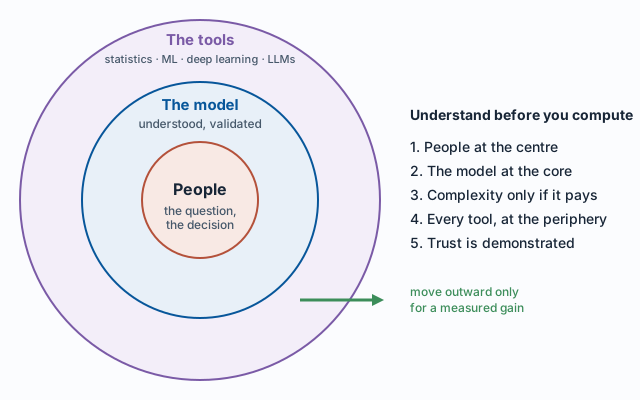
People and their question at the centre; a model we understand at the core; every tool around it, AI included. Complexity is added only when it brings a measurable gain.
In brief
- Cyril Voyant is a physicist and Research Director at Mines Paris – PSL (O.I.E.); he also worked for twenty years as a medical physicist in radiotherapy.
- His work spans solar and energy forecasting, forecast evaluation, radiobiology and language-model interfaces to scientific codes.
- One method runs through all these fields, named here concentric modelling: compute directly when the link is known, climb the complexity ladder only when needed, keep people at the centre and tools at the periphery.
- Every page of these sites states which of the five principles below it illustrates.
One method, every field: the complexity ladder
One method, every field
Cyril Voyant works on very different questions: the dose of a radiotherapy treatment, the response of thyroid cancer to radioiodine, the production of a solar plant, the electricity mix of an island, the load of a road tunnel, a request written in plain language. Medicine, energy and language are treated the same way. The domain changes; the method does not.
Start with the direct approach
When the link between inputs and outputs is known, compute it. Radiobiological dose equivalence follows an explicit model (LQL-Equiv); a compartmental model describes radioiodine kinetics in thyroid cancer; when no measurements exist, a tunnel's load is simulated from what is known (Tunnel Load Simulator). Before forecasting a signal, describe what in it can be predicted (sCV and F).
Climb the complexity ladder only when needed
If the direct approach is not enough, climb one step at a time: a simple reference (persistence), a structured reference (BLEND, CLIPER, ARTU), a statistical model, a frugal learning machine (ELM), and only then deep networks or foundation models. Each step is kept only if it beats the previous one under the same protocol, which is what NICE and the out-of-sample benchmarks measure. In thyroid modelling, the next step adds an ELM where the compartmental model is not enough; in satellite forecasting, a per-cell ELM beats whole-field deep models with a thousand times fewer parameters; for the Corsican electricity mix, an ELM learns the links between sources that no equation gives.
Language models: a tool on the ladder, not its top
Language models are used and useful: they read a request written in plain language. They do not replace a validated model. In WebSemantic, a language model maps the request to the inputs of a validated code, and the code computes every number.
Trust is demonstrated
Whatever the field, the result is evaluated with metrics that match the question (NICE, the temporal γ-index), published with its code, data and limits, and archived with a DOI. This is the point of the RTVACOS framework: research must be found, trusted and reused.
The thread. In medicine, energy and language alike: compute directly when the link is known; otherwise climb the complexity ladder one step at a time, and only as far as it pays; keep people at the centre.
The five principles
People at the centre
A forecast or a calculation serves a human decision: a physician, a grid operator, an engineer. The question and the responsibility stay human.
In the work: Twenty years of clinical radiotherapy, where every computed dose concerned a patient; forecasts designed for the operators of island grids.
The model at the core
Understand first: physics, signal structure, statistics. Compute directly when the link between inputs and outputs is known; let the machine learn it when it is not.
In the work: Radiobiological dose equivalence computed directly (LQL-Equiv); variability understood before forecasting (sCV and F); signal structure exploited (BLEND).
Complexity only if it pays
No a priori on the method: start simple, and climb only if, and only as far as, it is needed. Each step — persistence, structured reference, linear model, extreme learning machine, deep network — must beat the previous one under the same protocol. Simpler is often no worse, and sometimes better.
In the work: Errors measured against persistence (NICE); demanding simple references (BLEND, ARTU); a per-cell ELM beating whole-field deep models with a thousand times fewer parameters (satellite study); frugal benchmarks.
Every tool, at the periphery
AI belongs in every toolbox, not in every solution. Machine learning, deep learning and language models are valuable and used; they remain tools around an understood, validated core: a language model may prepare a calculation, never guess it.
In the work: Multi-output machine learning where the links are unknown (MIMO-ELM), compared with LSTM, U-Net and foundation models; language models that map text to the inputs of validated codes (WebSemantic).
Trust is demonstrated
Evaluate with metrics that match the question; publish code, data and limits; make reuse possible.
In the work: The temporal γ-index, carried over from radiotherapy dose verification; the public audit and correction of BLEND; open code with DOIs and Software Heritage archives; the RTVACOS framework on rigour, transparency, visibility and adoption.
The evidence, argument by argument
Every page of these sites is an argument in this story. Here is what each one shows.
When the link is known, compute it directly
The direct approach is the first choice in every field, because it is exact, explainable and needs no training data.
- LQL-Equiv: radiobiological dose equivalence (BED, EQD2, NTCP, TCP) computed from the linear-quadratic-linear model, checked against the 2014 MATLAB version on 4,438 schedules.
- Radioiodine therapy in metastatic thyroid cancer: a compartmental model of activity decay, tumour growth and thyroglobulin kinetics (Scientific Reports, 2026).
- Tunnel Load Simulator: no measurements exist, so the load is simulated from geometry, traffic, ventilation and lighting: one year at 10-minute resolution in about 150 ms, with P10–P90 envelopes.
- sCV and F: how variable and how forecastable a site is, described before any model is fitted.
When it is not, let the machine learn it — frugally
Machine learning is used where no equation links the inputs and the outputs, starting with the lightest learner that does the job.
- MIMO-ELM: a simple, parsimonious and frugal learner: one extreme learning machine forecasts seven grid signals of Corsica at once; one hour ahead, nRMSE 0.179 for solar and 0.051 for thermal, trained in closed form in seconds, ahead of an LSTM tuned with a realistic budget.
- PV_ELM_pred: persistence, BLEND, autoregression and 14 ELM variants on the same splits, parameters counted next to the error.
- Thyroid, next step: an ELM is added where the compartmental model is not enough (work in progress).
- Dimensionality reduction: the input is compressed only when the compression serves the forecast.
Climb only if it pays
No a priori on the method: start simple, and climb if, and only if, it is needed. Each step must beat the previous one under the same protocol; most of the time the climb stops early, and the simpler model is not only no worse, but sometimes better.
- Clearsky-free forecasting: removing the clear-sky model makes the forecasting chain simpler, and the ELM matches or outperforms ARMA with McClear clear sky and quantile regression, deterministic and probabilistic (Solar Energy 294, 2025): simpler is not worse, and sometimes better.
- How much space is enough: an ELM reading its own cell (nRMSE 0.308) beats the same ELM reading the whole field (0.355) with a thousand times fewer parameters, and also beats U-Net (0.343) and LSTM (0.326).
- BLEND and CLIPER: persistence references built on the cyclostationary structure of the signal, hard to beat before any trained model.
- ARTU and stochastic persistence: second-order and clear-sky references, computed by hand.
- Deseasonalization: the seasonal structure is removed only if doing so improves the forecast.
Measure what a model adds
A model is judged against a reference and with tolerances that match the use, never on a raw error alone.
- NICE: the error divided by that of persistence: 1 means no better than persistence.
- Temporal γ-index: a forecast judged within explicit tolerances in space, time and intensity, a method carried over from radiotherapy dose verification.
- BLEND v1.1.1: a public audit and correction of the open code, with out-of-sample results.
Language models: a tool, not the solution
AI belongs in every toolbox, not in every solution.
- WebSemantic: left alone, a language model fills gaps by guessing, which changed results by up to a factor of 2.6 in plausible interpretations; here it only maps words to the inputs of a validated code, which computes every number.
Trust is demonstrated, and reuse made possible
Code, data and limits are published, archived and citable, so that the work can be found, trusted and reused.
- Research excellence: the RTVACOS framework (rigour, transparency, visibility, adoption) and the op-ed on research in an age of saturation.
- Methods and code: open repositories with Zenodo DOIs and Software Heritage archives, one guide per method.
All the work at a glance
Short biography
Cyril Voyant is a physicist and Research Director at Mines Paris – PSL (O.I.E.). After twenty years as a medical physicist in radiotherapy, he works on solar and energy forecasting, forecast evaluation and frugal AI. His approach: understand the problem with a model first, add complexity only when it pays, and keep people, not tools, at the centre.